Watch Review
AP Royal Oak 15510ST Green Tapisserie: The Watch That Changed Everything, Again
The Royal Oak reinvented luxury watchmaking in 1972. The green dial does it again — quietly, without apology.
In 1972, Gérald Genta drew the Royal Oak in a single night for a brief that asked for something impossible: a luxury steel sports watch, with an integrated bracelet, priced above gold pieces from houses with centuries of credibility behind them. The watch that came out of that night broke every convention in Swiss watchmaking and spent the next fifty years being right about it. It was introduced in 2022.
The ref. 15510ST — the current 41mm Royal Oak Selfwinding — carries that history without being crushed by it. In the khaki green Grande Tapisserie dial, it wears it well.
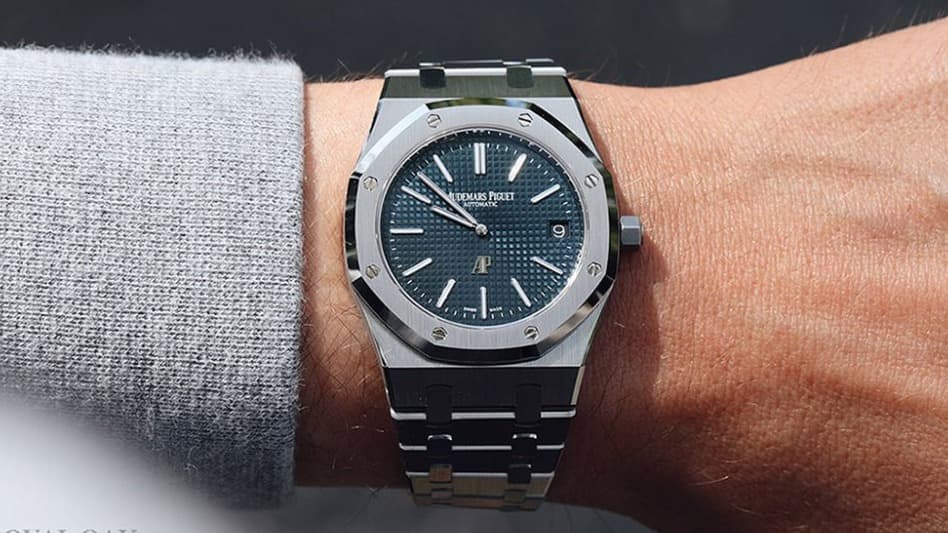
The dial is the whole conversation. Grande Tapisserie is a guilloché texture applied to the dial surface, creating a checked three-dimensional relief that reads differently at every angle and under every light. In silver or blue it's classical — austere, precise, architectural. In khaki green it becomes something else: deep and almost military in low light, distinctly alive in sun. AP calls it nature-inspired without specifying which part, which is either evasive or appropriately poetic. What matters is that it's a dial worth staring at, which is the only real test.
The case is 41mm across the dial, but the octagonal bezel — eight polished hexagonal screws, alternating brushed and polished surfaces running across the case and into the bracelet — makes it wear closer to 38mm visually. The alternating finish is one of the most technically demanding elements in production watchmaking. Run a finger across the bracelet: brushed metal and polished metal separated by an edge that allows no imprecision. It's the detail that justifies the price conversation better than any spec sheet.
Inside: the calibre 4302. Sixty-hour power reserve, 4Hz, skeletonised rotor visible through the caseback. The movement is designed to sit inside a case that is, at 10.4mm, almost aggressive in its thinness for a self-winding watch. It fits because AP built the calibre specifically for this case, and that relationship is visible when you look through the back.
At roughly $28,700 MSRP the Royal Oak is expensive by any standard that isn't Patek or Richard Mille. The green dial commands a secondary market premium above standard references — $35,000–45,000 for a well-documented example, depending on timing. AP has improved availability meaningfully over the past few years, but this is still a watch you plan for.
The case for it is simple: it's the most influential sports watch design in history, in a dial variant that makes a fifty-year-old silhouette feel genuinely current. That's harder to pull off than it looks.