Watch Review
Rolex Yacht-Master 40 Rhodium: The One That Makes the Most Sense
The Yacht-Master has always lived in an awkward spot in the Rolex lineup. The rhodium dial version quietly resolves most of the argument against it.
The Yacht-Master has never been the easiest Rolex to defend. It's not a tool watch — not really, despite the nautical name and the rotatable bezel. It doesn't have the depth rating of a Submariner, the gravity of a Daytona, or the institutional weight of a Datejust. For years it sat in an uncomfortable middle position in the catalogue: sportier than a dress watch, less purposeful than anything in the professional line. Attractive, clearly. Necessary, harder to argue. It was introduced in 2019.
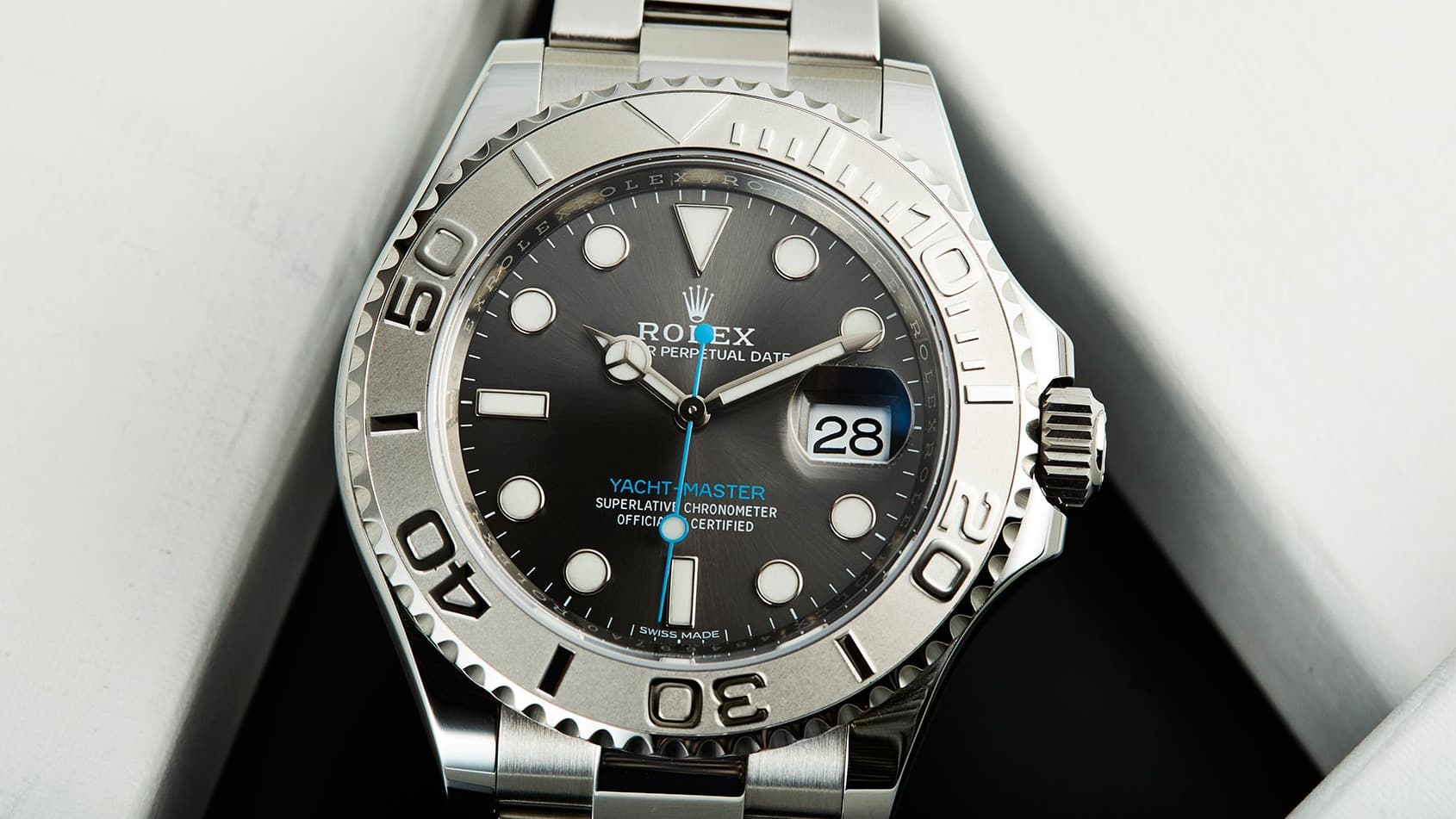
The ref. 126622 in Oystersteel with the rhodium dial is the version that finally settles the argument.
Rhodium is a plating process — the dial is silver, treated with a thin layer of rhodium that gives it a cool metallic grey shifting between steel and slate depending on the light. Not flashy, which turns out to be exactly right. Against the polished and brushed Oystersteel case and the platinum bidirectional bezel, the watch reads as one coherent piece. Cool metal throughout. Tonal consistency at this level is harder to achieve than it looks, and Rolex doesn't always manage it at 40mm.
The case is 40mm, 12.2mm thick, 47mm lug to lug. It sits comfortably on most wrists without dominating them, which the newer 42mm Yacht-Masters don't always manage. Water resistance is 100m — enough for sailing, not for diving, which is an honest reflection of what this watch actually is. The Oyster bracelet is well finished and the Easylink clasp adds 5mm of adjustment without a tool. On a hot day or after a long flight, that small thing matters.
The movement is the calibre 3235. Seventy-hour power reserve, Chronergy escapement, Superlative Chronometer certified to +/- 2 seconds per day. It runs correctly. You won't think about it. That's the ideal outcome for a movement at this level.
The bidirectional rotating bezel with raised polished numerals splits opinion. Some find it fussy against the clean ceramic bezels on the Submariner and GMT-Master II. In person the platinum reads as substantial rather than busy. It rewards slow attention without demanding it.
At around $11,550 MSRP it sits above the Submariner Date and below the GMT-Master II Pepsi. On the secondary market it trades near retail — none of the irrational premiums that follow the bigger names, which cuts both ways. You can buy one at something close to a fair price. The market also isn't treating it as a trophy.
What it is: a very good 40mm Rolex in steel with a better dial than most of the line, a profile that works with a suit or a weekend shirt, and a movement that will outlast whoever buys it. The nautical identity is mostly aesthetic at this point. That's fine. Not everything needs a reason beyond looking exactly right on the wrist.